1. The Glory of Handcrafted Design
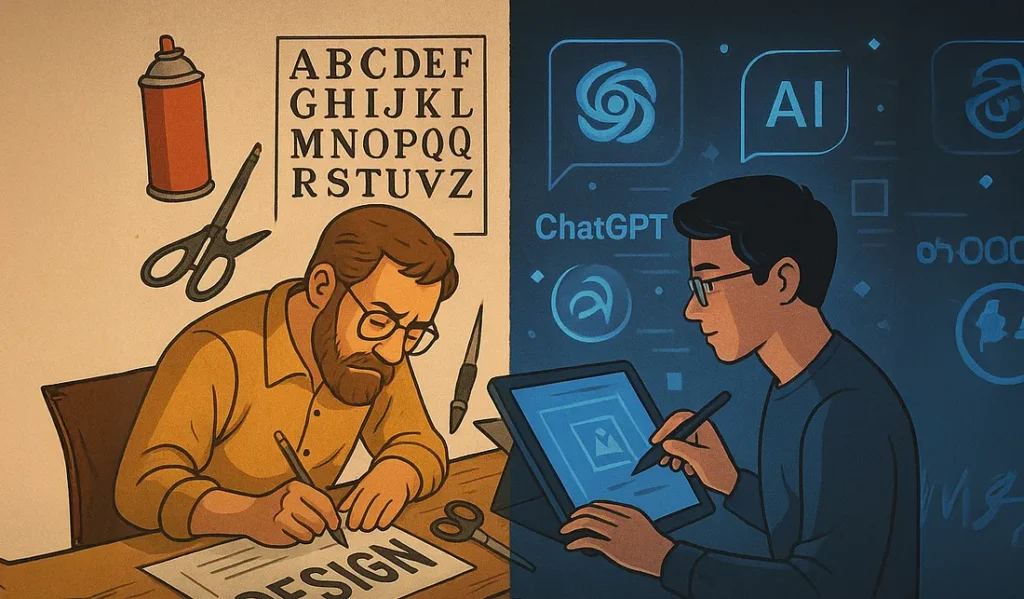
In the early days of my design career, everything was handmade — and there was immense pride in that. Whether it was typography done with a brush, picture collages cut with a scalpel, or background textures sprayed by hand, it was a badge of honor to say, “I did this myself.”
There was no shortcut. Every creation was a product of long hours, steady hands, and pure skill. Back then, owning that skill meant everything.
2. Enter the Computer: A Threat to Tradition
Then came the computer. I still remember my college days in late-90s Pakistan when the first design machines arrived. The shift wasn’t welcomed. Senior designers, many of whom had built their careers on manual techniques, scoffed at the idea of using a machine to create art.
They’d proudly declare:
“I’m not a shortcut designer — I work with my hands.” “These kids don’t even know how to draw a gradient manually.”
If you tried using a computer, you were seen as lazy, unskilled, or worse — a sellout.
3. The Brave Few Who Took the Leap
But some of us — curious, determined, maybe a little reckless — started experimenting. It wasn’t easy. Early design software was complex. Results weren’t great. And the disdain from experienced designers didn’t help.
Still, we pushed on. We made mistakes. We learned. And gradually, we mastered the tools. Fast-forward a few years, and those same “machine designers” were setting the pace for an entirely new creative industry.
“Every creative generation faces new technology that first feels like a threat. But the ones who adapt become the leaders. Here’s a personal story that shows why embracing innovation is the way forward.”
4. The Internet Shift: Research Redefined
Then came another disruption: the internet. Older creatives scoffed at online research. “Real knowledge is in books,” they’d say. But soon, deadlines got tighter, briefs got sharper, and traditional methods couldn’t keep up.
5. Shutterstock and Stock Libraries: Friend or Foe?
When stock platforms like Shutterstock emerged, another wave of resistance hit. People mocked others for using stock images:
“Your design came from Shutterstock, didn’t it?”
But again, these tools weren’t meant to replace creativity — they were meant to support it. By outsourcing basic elements, designers could focus on what truly mattered: ideas, storytelling, and originality.
Those who used stock libraries wisely saved time and elevated their work. Those who mocked them? Eventually started using them quietly too.
6. The AI Revolution: Déjà Vu All Over Again
And now, in 2023, history repeats itself. AI tools like ChatGPT, Midjourney, and others are shaking up the creative world.
Some proudly say:
“I made this without any AI.” “AI can never replace human creativity.”
They’re not wrong about creativity — but they’re missing the point. AI is not a replacement for ideas. It’s a partner, a super-assistant, a catalyst that can amplify your creativity and free you from repetitive tasks.
7. Embrace or Erase: The Choice Is Yours
Let’s be clear: AI is not optional anymore. It’s here. It’s powerful. And it’s only getting better.
Just like with computers, internet research, and stock images — resisting AI won’t stop its rise. What it will do is make you irrelevant.
Instead of fear or pride, we need curiosity and adaptability. Learn how AI tools work. Use them as assistants. Let them handle the heavy lifting, so your brain can focus on brilliance.
8. Evolve to Stay Relevant
The creative industry doesn’t reward effort — it rewards results. And those results now demand speed, relevance, and future-readiness.
Using AI doesn’t make you less of an artist — it makes you more efficient, more marketable, and more future-proof. The tools are here. The question is: Will you use them, or ignore them and fade away like those who resisted every wave before?
Conclusion:
Every major leap in design history started with fear and ended with transformation. AI is just the next chapter. Don’t let pride rob you of progress. Use every tool available to you — not because it’s easy, but because it’s smart.
It’s not man versus machine. It’s man with machine versus time.
What do you think?
It’s a modern look and suits up-and-coming brands that offer a unique product or service.